Tuesday, 20 April 2010

Please come to the Opera House, Langtry

Out in Texas on a road-trip, I drove west as far as Langtry, as far as I dared before I had to turn again to reach Austin in time. It was a dot on the map next to the Rio Grande. And when I got there, here's what I found.

At the end of the 19th century, Langtry was ruled by Judge Roy Bean. 'I am the law west of the Pecos River', declared Judge Bean to the rest of the USA. His courthouse doubled as the saloon bar, dispensing hooch and justice. When the US banned a heavyweight boxing match, Judge Bean stepped in and hosted the bout in Mexico, literally yards over the border on a sand-bed. He made money and a name for himself, cock-snooker.

There's a story about how the town came to be called Langtry. This story may not be true, but I want it to be so and that's more important.

It had been called Vinegaroon, after a scorpion-like creature called the Vinegaroon, that when startled does not have a sting in its tail but rather squirts a cloud of vinegar at its attacker. Handy if you're making salad dressing.

Judge Bean changed the name to Langtry because he was obsessed with English music-hall star Lillie Langtry. Certainly, he hung her photo over the bar. He probably dreamt of her. He christened his house the Opera House so this cock-snooker west of the Pecos River could write to invite her to the Opera House, Langtry.

Lillie Langtry did visit the town that was her namesake.

But not until a year after Judge Bean had died.

------------------------

Vinegaroon


The Opera House


Lillie above the bar


Police Gazette report on the bout


Old house


Rio Grande

Sunday, 11 April 2010

Time, it's a funny thing

I did a Peachy Coochy - the live art world's version of Pecha Kucha - on request of Tipping Point last summer as part of a night of reflections on climate change. A friend just requested I share words and pictures, so all follow.

---------------------------------


I've never done a Peachy Coochy before. I was invited a week ago to do this one. I did a first burst of writing for it last Friday. Then procrastinated. And most of these slides I made this afternoon. Pretty much at the last minute. Then timed how many words I can speak in 20 seconds. Near enough.


What do you worry about? Recently I was researching happiness and wellbeing in teenagers. Some of that research was just asking them straightforward focus group stylee questions. Each group was asked collectively to arrange these particular concerns in order of importance for them. What did they worry about even? Could they agree?


Here's the typical answer for a group. The top for all groups were friends and family, followed by relationships. Social. That's important to remember. One kid actually laughed "Is anyone worried about the environment?" It was even beneath 'what's in the news?' because a couple were freaked out by swine flu.


John Berger on the procrastination of smoking. ‘A cigarette’, Berger said, inhaling deeply, ‘is a breathing space. It makes a parenthesis. The time of a cigarette is a parenthesis, and if it is shared you are both in that parenthesis. It’s like a proscenium arch for a dialogue.’”


I once designed a social game about The Tragedy of the Commons. This is a thought-experiment published in Science in 1968, the year before I was born. Imagine you're all shepherds grazing sheep on common ground. Where's the tragedy in that? Here it comes.


You get richer as an indvidual the more sheep you graze. But the more sheep collectively are grazed by all shepherds, the common ground is ruined. In the game, one group turned it into desert. You're always telling yourself that if the others are cheating, why shouldn't I?


In 1985 when I was a teenager my favourite film was Rumblefish. nd my favourite scene was a monologue on time by Tom Waits. I couldn't find it on the interweb, it exists only in the dark past of human knowledge. All I can remember is it starting 'Time, it's a funny thing'.


Here's a little test. For the duration of the next slide. I'll buy a pint for the first person who stands up and waves their arms. But if you all stay seated and still, I'll donate £10 to Plane Stupid. I promise. Ready Steady Go.


………………………………………………………………………………………


As I write this a couple of hours ago, I don't know what's just happened in the future. I suspect that someone may have shot up and then sat back down again protesting that they don't want to spoil it. Or that everyone sat expectantly, their gaze a gentle pressure. Are we ever otherwise aware of that gentle pressure?


50 years ago a Disneyland episode called Magic Highway predicted the future of transport. Here's a shot of the tubular highways that should have been criscrossing the globe. What struck me was just how few cars they imagined in the future. Some of their gadgets - like the cliff elevator - only worked for one family car at a time. They didn't show any waiting traffic.


50 years ago, here is a family in their camper van. We're often told that it's our grandchildren who will pay for our treatment of the planet. I wonder about the alternate reality in which everything happened 50 years sooner. Where our grandparents fucked up and we are their grandchildren.


Here's another experiment. If you ask people how happy they think they will be in a month's time. It matters what the weather is like when you ask them: if it's sunny when you ask them the question then they are more likely to imagine they will be happy in the future than if it is raining.


I was googling for an image of a snooze alarm because I snoozed a lot this morning. I found this gadget. It's called a Snuz N Luz. Everytime you press the snooze button it automatically donates money from your bank account to a charity that you hate. In this case, for geek.com, the Republican Party.


There were plenty experiments I found in my research that demonstrate we're happier when we make quick decisions that satisfy us, rather than agonising over decisions. Agony. That's the word we use. And we like to make choices from limited options. Two or three most. Not the freedom of choice so much as the tyranny.


Here are three choices.
Experiments reckon that in a choice of three like this we look for two that we can compare and take the one that's better. So here we'd most likely choose the bottle that's £8. But if we took away the option of the £15 bottle, choosing between the top two only, we'd choose the £7 bottle


Here are another three choices. Of course I constructed this rather rhetorically. But still, I wonder if these are the three choices we always are presenting to ourselves in our minds. And of course, I'm still sticking with the middle of the road choice.


In 2007 an alternate-reality game called World Without Oil asked people to write on the interweb the imagined stories of their own lives. As if oil was running out here and now. I thought it was a brilliant idea for a game. But then it didn't look like much fun to keep playing. Rather like a lot of hard work.


Sometimes I have a solipstic fantasy that everyday I am dying. In one way or another. But that a couple of minutes before I die in one universe, I skip into an alternate reality and avoid death. In my fantasy, it's exactly like slipping into the next lane on the road and overtaking myself.


As an epilogue. I'm writing these slides 2 hours ago and I can't help but worry that I am sounding worthy, preaching to the converted. Here's an image I found by googling crazy preacher to put a face to my fear. It's the Reverend Billy. Thanks.

Monday, 29 March 2010

Ryan Stevens and the Man from Mars

Ryan
Stevens


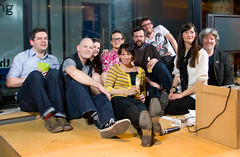
And a smattering of our lovely audience. Photos by Paul Bennun.

Jimmy Stewart... strode into performance at BAC earlier this month. I'd been fearful - not just that its personal resonance wouldn't overwhelm but also quite simply that it wasn't going to be rubbish... you never know, and I've never done anything previously to put myself on the line quite like it. Or learnt an hour-long text.

But in the end, it was a quite beautiful experience to be a part of and some very lovely, generous responses from audience afterwards. Thanks to all of them who played the Planet Earth - entirely from a sitting position, but taking a very central role especially in one section.

Thanks to Tracky Crombie who wove beautiful light with love and to Chris Goode our outside eye for the afternoon, although his kind words risk this turning into even more of a love-in but it has to be said for a so-called maverick he's really very good at the nuts and bolts of staging a piece simply and saying the right things to get the most out of a nervous actor.

And thanks to Nick, the Ryan in Ryan Stevens, for being a glorious other half of sound and music. One genius moment when I took my first step into the story and a sample of treading into snow deep and crisp and even - I couldn't stop grinning because the biomechanical feedback from the sound is so strong that each step actually physically felt like I was wading through snow.

Here are some words from Jimmy Stewart... which give some of its rather peculiar character. The hugging machine actually exists in the house of Temple Grandin, although I reimagined and let it out for a run inspired by seeing massage machines in a motorway service station. You'll have to hear Nick's extraordinary soundscape in your head as you read it.

You can usually find a hugging machine in a boat-train terminal. There'll be a line of them between the amusement arcade and the branch of Starbucks next to Departures. A hugging machine looks like a big comfy chair, cushioned as soft as a rabbit's cheek. You curl up inside it. Sometimes there's a frame in your eyeline to accommodate a photograph you may be carrying of a loved one. You place a coin in the slot underneath your right hand. Most hugging machines take Euros nowadays. Its motors hum and it grasps you first by your shoulders, then wraps itself entirely about you. Its hug is neither gentle like a grandmother nor tight like a grieving bear. The amplitude of hug is tuned to that which happens between humans who are lovers of at least three years' standing who are separating for a week or two but no doubt they'll see each other again soon. This is the most profitable hug in a marketplace of disconsolate commuters.

Small Town revisited

Here's a video documenting, as much as is possible in a short video, something of what it was like to be in A Small Town Anywhere.

Small Town Anywhere, BAC 2009 from Greg McLaren on Vimeo.

Saturday, 27 March 2010

Playing in a city

Following are my notes from a panel I spoke at in Tokyo as part of Connected, the British Council's expedition taking a bunch of interactive theatre artists to Japan. I was on the panel with Matt Adams of Blast Theory, Duncan Speakman of subtlemob, Yuya Tsukahara of Contact Gonzo, and Kensuke Sembo and Yae Akaiwa from exonemo.

The panel was on making art in cities, and followed the previous day's panel on the same theme from a group of producers and curators, including Andy Field of Forest Fringe who has already posted his notes here. I'm posting these 'cos Andy asked.

------------------

Coney is an agency of adventure and play
What does that mean?
It means we make live interactive play.
Live meaning that it is responsive and talks and listens to you, the audience, and responsive too for who you are and where it is happening.
And that it's all about the audience. You are it.
The story happens wherever you are and it might be all about you and you take the leading role.

Oh and part of the game of Coney is that it is led by Rabbit. Which might be this but more likely this. But more on Rabbit in my twelve noon presentation.

Coney and digital: Because the event is about the audience, we often talk to them using digital technology to bring them into the story wherever they are.

Digital infrastructure means that we can bring people to work that is happening in any place.
People were talking yesterday about flashmobbing. It's a tool to gather an audience together.
At the end of the adventure that we made happen in around and about the National Theatre, the playing audience were assembled on the north bank of the river facing the National.

They were waiting for a signal, they didn't know what it would be.

They were in the perfect place to see the gigantic illuminated sign on the front of the building that normally advertises the plays at the National suddenly changed to a message from Rabbit that led them into the adventure.

The National Theatre is a public institution with an architecture which reflects that role. An architecture that is used by people in particular ways.

We spent a while observing what the building is, how it is used and looking for its affordances for adventure.

This word affordance. I know it from perception psychology but it is also in interaction design. It is all the uses and properties of an object or an event or a place. Not just the ones that it is designed for. Some of them can be surprising, and you can make play with those.

With the National, another part was that Rabbit sent people on a little adventure into the story which involved them ringing a phone from a concrete symbol outside the building, going down into the carpark, finding their way into the lifts through a spooky door and going all the way to the top floors - which are completely empty during the day - and meandering down before going into the bookshop, buying an out-of-date leaflet on the history but knowing to ask the staff for it to be gift-wrapped with a wink, which gave them a package with...

By having an adventure in the building about the building we could transform the way people felt inside that place and the way they perceived the building.

It was really important that we used the reality of the building and its people in the story of the adventure, wrote the least possible fiction, because that meant that people wouldn't know what was real and what was Rabbit. Because the authorship is obscured, it means that everything could be part of it, and perceptions of your place are heightened and transformed.

After an adventure Rabbit led along the banks of the Thames on Valentine's night, one player wrote that their most memorable moment was meeting a busker who was playing Smells Like Teen Spirit on a banjo. They were almost certain that something so unusual and beautiful was part of the adventure. It wasn't. But it's the almost that's key, the uncertainty that is transformative.

This is public space. But that space is encroached by corporate space, private land owned by corporations who then determine the uses of that space. When Rabbit returns later this year it is likely in an adventure called The Green - SPOILER REMOVED - It's something that will start in London but then could happen in cities all over the world.

Here's something else about cities that interests me. Cities grow in similar ways so as much as they are different there are commonalities too. They may be uncontrollable but it is not without underlying principles. For example big cities are often on rivers, often by the sea. The areas near the docks will have been poor, with migrant communities refreshing every generation, unless the docks have fallen into disrepair when they will have first been transformed by artists, who always hunt for cheap space, and then by estate agents… You get the idea.

Buildings too. Institutional theatres, train stations, petrol stations, hotels, they have so much in common, wherever they are. They will have similar affordances for adventure and play, wherever they are.

And neighbourhoods. A little Coney seed piece made in collaboration by myself and Annette Mees in London with Hey Fan in Beijing, we have never met in the real world but over Skype. The piece is called Hutong. It's this red rectangle. You place it on a map of your neighbourhood at a scale of your choosing. And then you must walk the perimeter of the rectangle in your neighbourhood as best you can. Looking out for landmarks along the way - a place of books, a temple, a clock, happiness - landmarks that Fan saw when he made the first Hutong journey around the neighbourhood of Beijing that is itself called Hutong. And following other directions - on the south side, acknowledge all the dogs that you meet, on the east side, go into a cafe you've never been in before, ask the server what is their favourite hot drink and then have that. And anyone anywhere in the world can do their own Hutong. It makes you see the place in which you live in a different way and to make connections with strangers and strange places across the world, the beauty and mundanity of everyday life. Commonality and difference. The affordances of a place.

Pecha Kucha Fail

I was at the Dana Centre last night delivering a Pecha Kucha as part of Technology You Can't Live Without, curated by the splendid Aleks Krotoski, alongside a pretty daunting line-up of thinkers.


Our brief was to talk about a technology we can't live without and how we imagine technology developing over the next 5 years. I blithely ignored this and delivered the following, a personal history of failure with some musing on what happens through failure. And I have this weird foible of writing my words and then picking slides, so you'll get more from this than seeing my pictures. It made people laugh, maybe a bit too much, but hey.

1) This is currently my iPhone which I use to get wifi, to take photos, and to playtest a game I am making. But I cannot use it to make phone-calls because it has no sim card. This is my device of my last 12 months. It reflects my own personal history of failure with communications technology. Failure interests me. This is not an excuse for this presentation.

2) Technology is a facilitation of a human need to communicate. Said Alexander Graham Bell down the very first phone call in 1876: Come Here Watson I Need You. History does not record the nature of Bell's need for Watson but we can speculate. Perhaps he wanted a sandwich. They were two miles apart at the time.

3) The evolution of technology also affords new needs, in this case to communicate remotely. 39 years later Bell in New York would telephone Watson in San Francisco. But this evolutionary landscape is not just driven by the environment of human needs but also by those of economics of usage and accessibility. That first transcontinental call cost Bell a packet.

4) In the mid 1980's when I was a teenager I spent as much time as possible on the phone between coming home from school and settling on whatever I was doing for the evening. I'd call one friend and talk for a long time. I'd then call another friend, then another so that all of us knew what was going on. My parents would freak at the phone bill. But this was the glue of my life.

5) Talking to teenagers for research last summer, they chat to friends in the same time with the same need - between school and evening but using Facebook and IM. If they have broadband accessibility and their own computer rather than sharing with family then this is effortless free chat, affording a new need of many modes of communication simultaneously, not one to many sequentially.

6) I was a late adopter to the mobile phone. For several years I had a pager, first a numeric pager which meant that for us to communicate, I would have to find a payphone to ring the number you sent me, which might itself be a payphone in which you were standing and waiting. The knowledge that this might be so would make me run to find a payphone even when I didn't know who was trying to reach me.

7) Then I got a text pager. This would mean that you could send a text message to me but you would have to call a human operator, dictate your message to them which they would type and send to me. Often they would make mistakes, particularly on unusual names. I once failed to meet someone in a bar with an unusual name. I always regretted not meeting her.

8) But for all the fragility of my interface, pager networks are much more robust to heavy traffic than those for mobile phones which is why they remain in use for emergency services. On 7.7 it was the failure of the phone networks for several hours that made my parents, so used to the robust landline, unbearably anxious.

9) A few years ago, I sent a CD by parcel post from London to Edinburgh for a performance. The package was opened live on stage. The CD was instructed to be played but like many burned CDs it failed in the CD deck. The technician asked the audience if anyone had a Discman, miraculously someone did, the techie dangled a microphone onto its earphones and - just about - the voice on the CD could be heard. The audience stood and cheered at collectively overcoming this failure.

10) My first mobile was the old Nokia model. It's pretty robust, starts up quickly, just does messages. It's better suited to running live games than a more hi-fi model. I used my first phone to death, even when the keypad fell apart so that I couldn't press the keys with my fingers. Which meant that if it rang, I would have to find a pointy tool in my immediate environment - a pen or a matchstick or a twig - so that I could take the call.

11) My current mobile phone has a bug which makes it a time machine. Occasionally if you send me a text message it will rather send me another text message, one that you have already sent me in the past. I have been messaged countless times by one friend about a need for an espresso, by another about being sensitive to the anniversary of a bereavement, by another about recovering from an operation and I really should pop in for a coffee.

12) My family didn't get an ansamachine til 1985 so before then both me and a friend had to be standing simultaneously by an available phone in order to speak. Communication was location-specified. Recorded messages might be from the past, especially on a C90 tape, but they were the first step to afford mobility.

13) Technology both of the near past and of the near future is littered with failures. A failure of the past that I like very much is the Rabbit Phone, a location-specific mobile phone-service by Hutchison Telecom, one of four that started up in 1989. It was a bit like a wireless switchboard for a phone.

14) You could only use a Rabbit phone when you were within 100 yards of a Rabbit sign. And you couldn't receive incoming calls, only make outgoing. It went bust in 1994, but some companies bought the base station and handsets cheap to use as a wireless office phone. Cheap technology finds a new niche to thrive post-failure.

15) A BBC article in 2002 about the advent of wifi argues that the failure of Rabbit phones doesn't bode well for location-specific wireless internet hotspots. The only places that might make something out of it, reckoned expert Adam Zawel, were hotels which bundled in the charges with room rates.

16) In Austin airport there are free internet terminals but in Houston airport there is now a Boingo wireless network that you have to pay for, so the free terminals have been ripped out. But Boingo needs you to be online to download the app to get online so I had to feed five one-dollar bills into a pay-terminal for 10 minutes. The poor pay more.

17) Many internet cafes in London outside the centre are often run for diaspora communities. Computers in internet cafes are evolved to be super-optimised for chat programmes and for games. They meet the needs of communication and play, not just for migrants but for children and students, those who may not have access to their own machines.

18) Here in Houston Airport is another device, one that I have never seen before nor would have predicted. It's called a rapid charger where you pay to plug your phone or laptop or other device into a choice of cables. It's based on people not being smart enough to bring their own chargers. It may only thrive in this tiny niche where forgetful people have a long time between flights. It may fail.

19) Perhaps we have a tendency to imagine the future of technology as sleek and squeaky clean. Almost as if we are corporate creationists, we conceive that perfect devices are shaped from the clay. Where early adopters do the cleverest things. Even though occasionally the really clever affordances of technology aren’t always those of primary design.

20) The evolutionary environment for technology is messy, driven by failure. It is an environment in which needs and economics run amok, killing great ideas in the wrong habitat, preserving oddities in niches, It’s an enviroment which may yet change beyond recognition as the world changes. But I’m peculiarly reassured by how often our ingenuity can bridge the failure gap, how failure reveals the human.
Sunday, 7 March 2010

Tokyo > Mars > Texas

I haven't been here in a while, I've been in other places.

Spent last week in Tokyo as part of the British Council's Connected gang and had an immense time. Special pleasures not limited to these: to hear 'konichi-wa usagi desu' spoken by a Japanese accomplice, to meet an old friend from 20 years ago and eat delectable sushi, to wander under an umbrella in Live Art Speed Date before hitting Chatroulette with Mel Wilson, to get to know better a whole bunch of brilliant Brit talents, to speak on making Art in Cities as part of a really inspiring panel, to make connections with most exciting artists and producers from all over Asia, to find a lakeside memorial to two friends who overcame The Global Tides Of Bias (my next band name, when Death to Cattle finally blow the roof).

This week I'm off to Mars, as performing the play what I wrote - Jimmy Stewart, an Anthropologist from Mars, Analyses Love and Happiness in Humans (and Rabbits) - alongside Nick Ryan at BAC. If you are reading this, you are very welcome to come. It might be quite good and I don't do an American accent.

And then straight after I am off to Texas as part of the Arts Council delegation to South By South West interactive.

I'm the lucky one.