On my way last night to a meeting re The Loveliness Principle with Rhiannon and Rachael, its two brilliant co-makers; running late as ever. Debated whether to get a taxi as I was so late, but walked to the first bus stop. Ages for a bus, so walked on to the High Street, no cab firms in sight, down to the next bus stop, bus suddenly appeared and due in a minute.
But then a man appears asking for help as his car has stalled. It's not remotely altruism: there's no question but that when on the way to a meeting about this particular project, I have to help.
So me and another give him a push start, and thereby miss the bus. So he offers us a lift.
I accept and ask him just to take me to the nearest cab firm but he insists on taking me nearly all the way there. He's just grateful because his car is working, and he's on his way to the hospital to meet his grandson - his first grandchild - for the very first time.
Very very best to him, and I feel like the title of this post.
Monday, 14 February 2011

Sunday, 16 January 2011
Five years ago (almost)
Walking along the South Bank today I paused by a jetty that juts into the Thames. Five years ago (almost) it was one station in an adventure on Valentine's night that I was involved in making, a night of almost alchemical serendipity: nobody died; they made the boat in the nick of time; it was a mild, clear and moonlit February night; three pairs of people met and fell in (some kind of) love; although not made for any reason but the love of it, it catalysed pretty much everything that I find myself doing now.
Today there is one tiny memento of that adventure, a small and well-weathered loop of string that five years ago (almost) had something tied to it, itself now long gone. Spotting that trace, doing a double-take, felt like some kind of magic.

It's there, in the centre just below the lowest rail.
Today there is one tiny memento of that adventure, a small and well-weathered loop of string that five years ago (almost) had something tied to it, itself now long gone. Spotting that trace, doing a double-take, felt like some kind of magic.
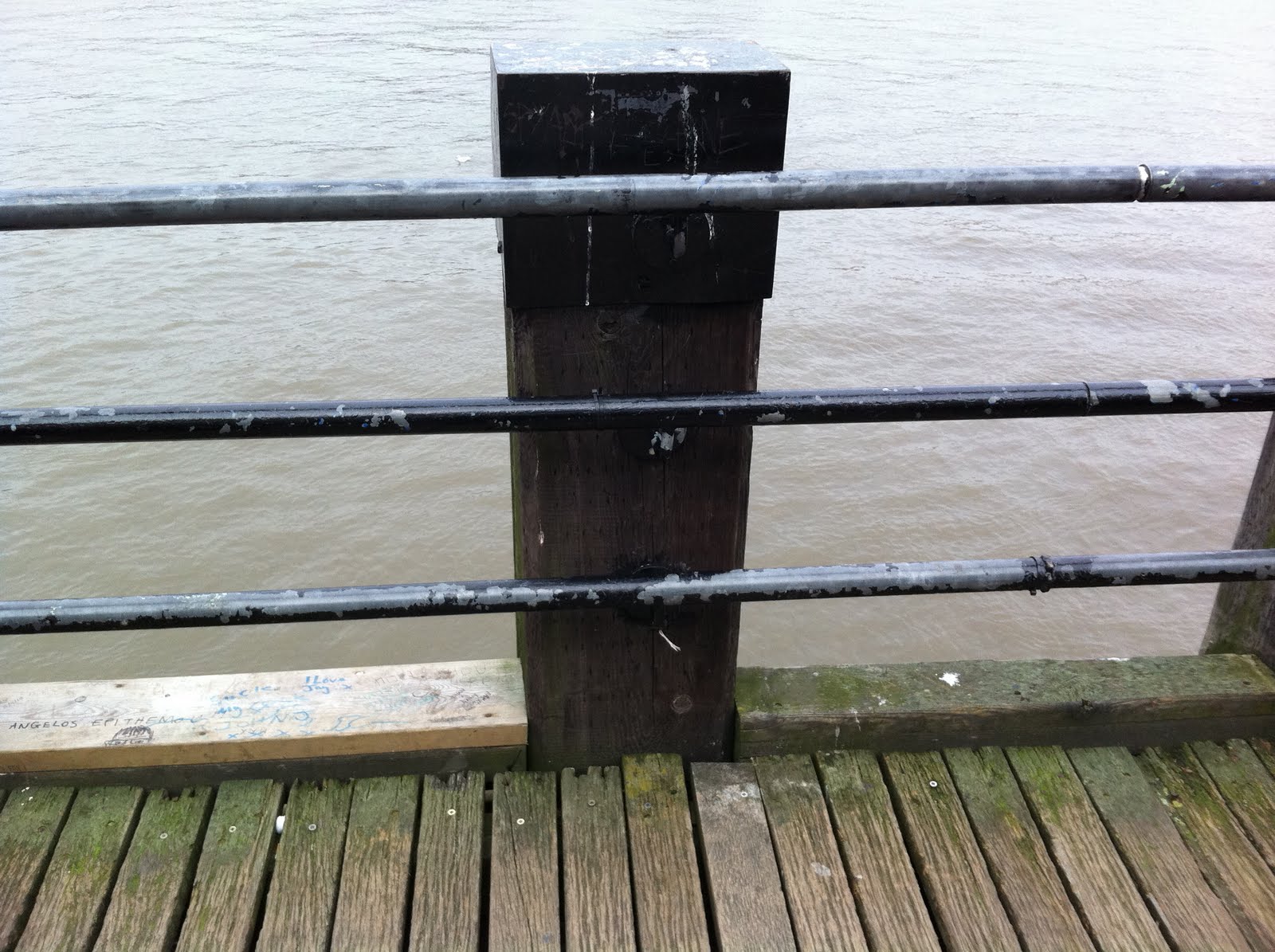
It's there, in the centre just below the lowest rail.
Saturday, 18 September 2010
The Challenge of Conventions
I'm winded by that last post, so this one is now a series of bullet-points that I hope to expand upon later.
This is a post that Annette Mees, one of my fellow co-directors in Coney, asked of me towards the upcoming pilot of Art Heist.
Flow Theory was reverse-engineered by Cziksentmihalyi from the question 'what are you doing now and how happy are you doing it'.
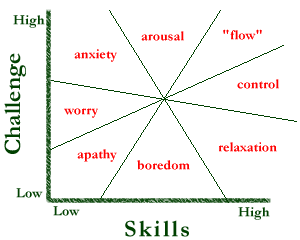
If you picture a graph with the challenge presented by your activity along one axis and the skills you have to meet that challenge against the other axis, then the sweet spot of flow is where the challenge slightly exceeds your skills, but where you can stretch yourself (or if you go via Vygotsky, stretch yourself with peers) to meet that challenge.
Aside: when you are in flow, there's often reported a sense of losing track of time.
On an Artist-Teacher Exchange Scheme at BAC, two educational psychologists recommended a teaching approach to give a group of kids a challenge, look to see if they are smiling in their eyes, if they are then they are in flow, leave them, if not, then adjust the difficulty of the challenge until they are.
Cziksentmihalyi shows an expansion of the array of emotions that are typically felt in the various imbalances of challenge and skill.
 So far, now this.
I think we can really usefully characterise as a challenge the experience of an audience from the conventions of a piece of art. They have varying skill for interpreting those conventions, contingent on their previous experience and understanding.
Challenge versus skill. Flowing around flow.
It's also a challenge to an audience to experience a story, which by continually provoking the implicit question 'what happens next' is challenging them to answer that in mind.
How perhaps the brilliant maxim of Improbable after Keith Johnstone - what we most want to happen next is what we didn't know we were expecting all along - is a reflection of being in the sweet spot of flow in the challenge of what happens next.
Look back at that graph of emotions. Think about yourself and the conventions of the art, story, music, play that you engage with in different circumstances and moods. And how you respond. That difficult play. The book you take for the beach. The game you play to unwind. Remember the last time you watched a film and time just flew by.
But your skill is not fixed. You learn, pretty quickly. A piece of work challenging with new conventions may be more widely appreciated if it itself helps its audience learn and master those new conventions as it unfolds.
-------------
Addendum.
Attribution theory. It's about how and where you attribute the cause of a situation/phenomenon. Crudely speaking, there's a difference between the default locus of attribution in being a participant and a spectator. A participant will tend to attribute to the situation. A footballer slips and misses a penalty and they'll blame the pitch. A spectator will tend to attribute personally: what a rubbish player. It's usually more complicated, but certainly you'd be a fool as a spectator to attribute personally based on one viewing only of that player.
Faced with art challenging beyond their experience, a conventional critic has to resist the temptation to attribute to the artist labels like wilful, self-indulgent etc. If they are to be a useful critic.
Addendum explaining (but not excusing) the existence of Christopher Hart at the Sunday Times.
This is a post that Annette Mees, one of my fellow co-directors in Coney, asked of me towards the upcoming pilot of Art Heist.
Flow Theory was reverse-engineered by Cziksentmihalyi from the question 'what are you doing now and how happy are you doing it'.
If you picture a graph with the challenge presented by your activity along one axis and the skills you have to meet that challenge against the other axis, then the sweet spot of flow is where the challenge slightly exceeds your skills, but where you can stretch yourself (or if you go via Vygotsky, stretch yourself with peers) to meet that challenge.
Aside: when you are in flow, there's often reported a sense of losing track of time.
On an Artist-Teacher Exchange Scheme at BAC, two educational psychologists recommended a teaching approach to give a group of kids a challenge, look to see if they are smiling in their eyes, if they are then they are in flow, leave them, if not, then adjust the difficulty of the challenge until they are.
Cziksentmihalyi shows an expansion of the array of emotions that are typically felt in the various imbalances of challenge and skill.
 So far, now this.
I think we can really usefully characterise as a challenge the experience of an audience from the conventions of a piece of art. They have varying skill for interpreting those conventions, contingent on their previous experience and understanding.
Challenge versus skill. Flowing around flow.
It's also a challenge to an audience to experience a story, which by continually provoking the implicit question 'what happens next' is challenging them to answer that in mind.
How perhaps the brilliant maxim of Improbable after Keith Johnstone - what we most want to happen next is what we didn't know we were expecting all along - is a reflection of being in the sweet spot of flow in the challenge of what happens next.
Look back at that graph of emotions. Think about yourself and the conventions of the art, story, music, play that you engage with in different circumstances and moods. And how you respond. That difficult play. The book you take for the beach. The game you play to unwind. Remember the last time you watched a film and time just flew by.
But your skill is not fixed. You learn, pretty quickly. A piece of work challenging with new conventions may be more widely appreciated if it itself helps its audience learn and master those new conventions as it unfolds.
-------------
Addendum.
Attribution theory. It's about how and where you attribute the cause of a situation/phenomenon. Crudely speaking, there's a difference between the default locus of attribution in being a participant and a spectator. A participant will tend to attribute to the situation. A footballer slips and misses a penalty and they'll blame the pitch. A spectator will tend to attribute personally: what a rubbish player. It's usually more complicated, but certainly you'd be a fool as a spectator to attribute personally based on one viewing only of that player.
Faced with art challenging beyond their experience, a conventional critic has to resist the temptation to attribute to the artist labels like wilful, self-indulgent etc. If they are to be a useful critic.
Addendum explaining (but not excusing) the existence of Christopher Hart at the Sunday Times.
Papa Bound Conventions
I spoke last week at the Media Arts Festival at the Roundhouse, on a panel on games chaired by Clare Reddington chair of the Pervasive Media Studio, alongside Margaret Robertson all-round game-egg of Hide & Seek, and Alice Taylor fab digital-game-commissioner for C4 Education, a splendid line-up to be asked into.
I spoke on Papa Sangre, a game I'm making for the iPhone alongside a brillliant array of collaborators. It's a game-(under)world that is rendered primarily in sound and music, so I got to ask the audience if they wanted to see a screenshot: just to close their eyes. The panel is online here, video 12 (you don't have to, even if you are my mum, this is just for my reference).
And now to digress, a lot.
Papa Sangre was commissioned by 4IP as a game that could be played by the visually-impaired as well as the sighted. Constraint being the mother of invention. Or in this case, the mother of incorporation.
The seed for Papa Sangre is a live game called Sangre y Patatas based itself on Blood and Potatoes, a game I'd run in theatre rooms for years. It's a game of stealth and cunning to avoid a bloody loud death, played with eyes closed. And I ran it for the usual reasons, general warm-up of brains and bodies, punctuate work with a shot of fun, etc. But also occasionally adapting it rapidly and iteratively to more interesting purpose, the game becoming an engine of exploration.
Here's another digression as an example of how. The very first show I directed professionally was The Bound Man at BAC in 1998, although it had started as a student production. To give due credit, it was a dark fairy-tale adapted previously into a performance text by Andrew Prichard from a short story by Ilse Aichinger; we'd then devised from that text. The text was itself a story conjured and told by two severed heads. A man wakes up in a forest to find himself bound head to toe in rope and before he can escape, is taken into a circus where he becomes the star act. The circus becomes jealous and the bound man is forced to face a wolf, and it ends - well, it just ends back with the severed heads frustrated in the darkness.
So there's a wolf. Played by a person, not (necessarily) on all fours, not in a furry costume, but just a person... who is transformed through a system of sense-movement adaptation to play like a wolf. This system had been devised by choreographer Alex New but it was not choreography to block a sequence of actions, rather a process to transform the weighting of your senses in play so you can't help but act as wolf. You don't even have to be a dancer. Alex was frighteningly and ineffably so, but an injury he'd picked up meant I had to take over for the first performances in college, and anyone who knows me knows how I dance... and even I could get by. It's incredible to play, without thinking you are acting like an animal. If you want to know any more, you'll have to find me and buy me a drink.
when it came to BAC, we cast the fittingly-named Dan Synge (say it aloud) as wolf, and he, Alex, myself and others from the company spent long sessions in a basement playing Blood and Potatoes, and rapidly evolving the game and plugging into it what we knew of playing wolf, to help discover more. One session ended up in pitch darkness, piles of chairs around the room to become a landscape of noisy hazard and refuge, one of us as wolf pursuing the others relentlessly. And then discovering that if counter-intuitively we added a tiny amount of light - one bar of an electric fire to be precise - then the glow it cast became a dangerous corridor we'd literally scamper across to avoid being caught. Dan's learning as wolf was shaped by the properties and constraints at play (and it was the most brilliant fun).
It's interesting watching people playtest Papa Sangre because even though movement in this case means walking with your thumbs, step by step, the immersion of the binaural sound all around you means that you feel like you're in that world, and your body starts to respond, scrunching in fear when you 'step' on something crunchy like bones exactly like real people playing Sangre y Patatas and stepping into a pile of tortilla chips. The experience is intensely present-tense, not least because you can't as easily conjure a map of a pitch-dark space to remember where you are.
This post is fast becoming a series of tangential digressions.
A lot of play is best kept plastic in form as it develops, until you find the shape, constraints, conventions of play that fit precisely what you need. Experimental isn't a euphemism for non-conventional, or even indulgent or weird, but a reflection of this process of iterative innovation. Conventional similarly doesn't mean boring or stuffy, but literally using conventions that are already generally understood by audiences which are sometimes therefore the most fit for purpose.
Nor is there only one set of conventions that are conventional. For instance - and this is not a dig at them - Punchdrunk are forever called experimental in mainstream press, but more often they use conventions established for what could be called their own conventional work; experimental here really just means a different set of conventions.
Back to the panel. Clare had asked us to ask a question directly for the audience and I ended up with a (relatively tame) provocation based on all the above: there is no inherent superiority in medium, genre or convention.
The challenge is to resist a properly conservative attitude which can become dangerously habitual for the risk-averse, that only the kind of work that you already know how to make is any good. The danger in these conservative times, with an uncertain funding landscape, is the temptation to play safe without an edge of experimentation. You'll end up stiff. Looking at you, broadcasters, in every medium.
I spoke on Papa Sangre, a game I'm making for the iPhone alongside a brillliant array of collaborators. It's a game-(under)world that is rendered primarily in sound and music, so I got to ask the audience if they wanted to see a screenshot: just to close their eyes. The panel is online here, video 12 (you don't have to, even if you are my mum, this is just for my reference).
And now to digress, a lot.
Papa Sangre was commissioned by 4IP as a game that could be played by the visually-impaired as well as the sighted. Constraint being the mother of invention. Or in this case, the mother of incorporation.
The seed for Papa Sangre is a live game called Sangre y Patatas based itself on Blood and Potatoes, a game I'd run in theatre rooms for years. It's a game of stealth and cunning to avoid a bloody loud death, played with eyes closed. And I ran it for the usual reasons, general warm-up of brains and bodies, punctuate work with a shot of fun, etc. But also occasionally adapting it rapidly and iteratively to more interesting purpose, the game becoming an engine of exploration.
Here's another digression as an example of how. The very first show I directed professionally was The Bound Man at BAC in 1998, although it had started as a student production. To give due credit, it was a dark fairy-tale adapted previously into a performance text by Andrew Prichard from a short story by Ilse Aichinger; we'd then devised from that text. The text was itself a story conjured and told by two severed heads. A man wakes up in a forest to find himself bound head to toe in rope and before he can escape, is taken into a circus where he becomes the star act. The circus becomes jealous and the bound man is forced to face a wolf, and it ends - well, it just ends back with the severed heads frustrated in the darkness.
So there's a wolf. Played by a person, not (necessarily) on all fours, not in a furry costume, but just a person... who is transformed through a system of sense-movement adaptation to play like a wolf. This system had been devised by choreographer Alex New but it was not choreography to block a sequence of actions, rather a process to transform the weighting of your senses in play so you can't help but act as wolf. You don't even have to be a dancer. Alex was frighteningly and ineffably so, but an injury he'd picked up meant I had to take over for the first performances in college, and anyone who knows me knows how I dance... and even I could get by. It's incredible to play, without thinking you are acting like an animal. If you want to know any more, you'll have to find me and buy me a drink.
when it came to BAC, we cast the fittingly-named Dan Synge (say it aloud) as wolf, and he, Alex, myself and others from the company spent long sessions in a basement playing Blood and Potatoes, and rapidly evolving the game and plugging into it what we knew of playing wolf, to help discover more. One session ended up in pitch darkness, piles of chairs around the room to become a landscape of noisy hazard and refuge, one of us as wolf pursuing the others relentlessly. And then discovering that if counter-intuitively we added a tiny amount of light - one bar of an electric fire to be precise - then the glow it cast became a dangerous corridor we'd literally scamper across to avoid being caught. Dan's learning as wolf was shaped by the properties and constraints at play (and it was the most brilliant fun).
It's interesting watching people playtest Papa Sangre because even though movement in this case means walking with your thumbs, step by step, the immersion of the binaural sound all around you means that you feel like you're in that world, and your body starts to respond, scrunching in fear when you 'step' on something crunchy like bones exactly like real people playing Sangre y Patatas and stepping into a pile of tortilla chips. The experience is intensely present-tense, not least because you can't as easily conjure a map of a pitch-dark space to remember where you are.
This post is fast becoming a series of tangential digressions.
A lot of play is best kept plastic in form as it develops, until you find the shape, constraints, conventions of play that fit precisely what you need. Experimental isn't a euphemism for non-conventional, or even indulgent or weird, but a reflection of this process of iterative innovation. Conventional similarly doesn't mean boring or stuffy, but literally using conventions that are already generally understood by audiences which are sometimes therefore the most fit for purpose.
Nor is there only one set of conventions that are conventional. For instance - and this is not a dig at them - Punchdrunk are forever called experimental in mainstream press, but more often they use conventions established for what could be called their own conventional work; experimental here really just means a different set of conventions.
Back to the panel. Clare had asked us to ask a question directly for the audience and I ended up with a (relatively tame) provocation based on all the above: there is no inherent superiority in medium, genre or convention.
The challenge is to resist a properly conservative attitude which can become dangerously habitual for the risk-averse, that only the kind of work that you already know how to make is any good. The danger in these conservative times, with an uncertain funding landscape, is the temptation to play safe without an edge of experimentation. You'll end up stiff. Looking at you, broadcasters, in every medium.
Tuesday, 13 July 2010
Make Believe by Jimmy Stewart
I was asked along to deliver a 5-minute provocation to Wonderlab today, and posting the essay here by request.
--------------------------
Hello, I’m Tassos Stevens. I’m a co-director and runner of Coney, an agency making play where it’s all about you, founded on principles of adventure, loveliness and reciprocity, amongst others.
But I am not here to talk about that. Actually I’ve brought along something to read by somebody else. There’s this writer I know called Jimmy Stewart – yep, just like but obviously not the Jimmy Stewart – and there’s a short essay of his that I’ve brought along. It does read a bit like an incomplete manifesto, but if he were here, he wouldn’t apologise for that. He’s at least half-Martian which makes his perspective somewhat alien and his language occasionally rather dense. But that’s probably why I like it.
So this is…
Make Believe by Jimmy Stewart
Play is make believe at the double. I look at something and I first see what it is, or at least what I believe it is, be it Simon Russell Beale, a banana, February 14th. But then I make believe what if that what is were something else: Hamlet, a revolver, the feast of St Valentine. What if. What is. We're playful when we hold two spheres of belief in our brains overlapping. Humans are really good at it. There’s facility especially when it's conventional, meaning we are practiced at it, or if we are in a collection of other human-people simultaneously doing that same juggle of spheres. But it’s most inspirational when we discover it ourselves together.
The distance between these two spheres of what if and what is, it's a dynamic space, sparking like the electrical storm of Van der Graaf. Sometimes so close the spheres are almost touching, sometimes miles apart, but the meaning of play is found across that distance. Still what if is only charged if it is grounded and connected to what is. There’s no chance of transformation otherwise.
Play is a live, fluxing reinvention, ever negotiated, always In Play. You can't make me believe anything unless I want to believe. I don't want to play by your rules, says the stubborn kid who is sometimes the very best of us. And it matters then in this negotiation whose rules, who is telling that stubborn kid what if, and even who is paying them to do so.
But the best play doesn't tell you how to act, play invites you to imagine what if and - if then - what do you want to do about it. It's a principled belief that creates an action-space, where the agent of play is you.
Peter Brook was a theatre director and once asked what it is for an actor to exit pursued by a bear. I see a bear, I feel fear, I run. I see a bear, I run, I feel fear. Two pursuits. Brook argues that they are equivalent, and it only depends on the actor and the director together which suits them best. Too true. But if you want an actor with agency, better to be governed by a principle than ordered into action.
Game arises from play. A ruleset crystallises a set of actions distilled from an experience of play. That crystal can be popped in your pocket to be played with again and again, any time, any place, with anyone entranced by its sparkle. It gets chipped and scratched, then rubbed and polished. It becomes a lens that focuses action in time and space and for one brief encounter let’s us act as if we lived in a simpler world, the kind of world that can be described in a ruleset. But the very best thing about it is that if we want to, we can smash it up and grind it into paste to make believe anew. Even if let alone, its inherent ephemerality will let it pass; like a playful version of the second law of thermodynamics, people stop playing attention and soon the game dissolves into flux. It’s the playful spirit of the game that’s more important than the letter of the rules.
Which is as it should be. Jane McGonigal says reality is broken and let’s fix it with game, a whiff of formalin in the air. Her lens on the world is rather monocular, fundamentalist in the proper sense of the word. It rarely admits failure and dreams of a superhumanity. But I think I can do no better than make play with people, and forcing them into one game they don’t want to play is like trying to choreograph butterflies.
Try to be a theatre director of any scene of people in play and you discover many games tumbling out at once - games of status, of desire, of curiosity, of connection, and of greed, of all the sins and of all the virtues – plus hope – and as an actor here you can’t stop still, moment by moment a different game crackles into life. And in reality, these games are all being played all at once: by different people at different times in different places, interrupting and overlapping. If you look at the crystalline complexity of reality through a monocle, no wonder it looks broken.
Reality is broken. To which the only true playful response is: Yes And. A cascade of Yes Ands, with the odd Yes But, an occasional No Thank You, one step at a time.
Actually it’s where reality breaks that matters. Where one game breaks down and you choose to start playing another. Or simply because someone else asks you to play nicer for them. Augusto Boal was another theatre director who never stopped playing what if with reality, again and again, until it broke and then he asked the audience if they had a better idea and if they wanted to get up and do it.
As a society, as individuals, it’s how we respond to fail more than to epic win that matters. It’s in fail that we find the dimensions of our capacity for resilience: connectedness, the ability to be stretched, our very own agency, powered by accurate reflection of what is with still space to dream what if.
--------------------------
That’s as far as Jimmy got. Slight hyperbole there at the end, sorry about that.
And, by uncanny coincidence, that’s all I’ve got too. Thanks.
--------------------------
Hello, I’m Tassos Stevens. I’m a co-director and runner of Coney, an agency making play where it’s all about you, founded on principles of adventure, loveliness and reciprocity, amongst others.
But I am not here to talk about that. Actually I’ve brought along something to read by somebody else. There’s this writer I know called Jimmy Stewart – yep, just like but obviously not the Jimmy Stewart – and there’s a short essay of his that I’ve brought along. It does read a bit like an incomplete manifesto, but if he were here, he wouldn’t apologise for that. He’s at least half-Martian which makes his perspective somewhat alien and his language occasionally rather dense. But that’s probably why I like it.
So this is…
Make Believe by Jimmy Stewart
Play is make believe at the double. I look at something and I first see what it is, or at least what I believe it is, be it Simon Russell Beale, a banana, February 14th. But then I make believe what if that what is were something else: Hamlet, a revolver, the feast of St Valentine. What if. What is. We're playful when we hold two spheres of belief in our brains overlapping. Humans are really good at it. There’s facility especially when it's conventional, meaning we are practiced at it, or if we are in a collection of other human-people simultaneously doing that same juggle of spheres. But it’s most inspirational when we discover it ourselves together.
The distance between these two spheres of what if and what is, it's a dynamic space, sparking like the electrical storm of Van der Graaf. Sometimes so close the spheres are almost touching, sometimes miles apart, but the meaning of play is found across that distance. Still what if is only charged if it is grounded and connected to what is. There’s no chance of transformation otherwise.
Play is a live, fluxing reinvention, ever negotiated, always In Play. You can't make me believe anything unless I want to believe. I don't want to play by your rules, says the stubborn kid who is sometimes the very best of us. And it matters then in this negotiation whose rules, who is telling that stubborn kid what if, and even who is paying them to do so.
But the best play doesn't tell you how to act, play invites you to imagine what if and - if then - what do you want to do about it. It's a principled belief that creates an action-space, where the agent of play is you.
Peter Brook was a theatre director and once asked what it is for an actor to exit pursued by a bear. I see a bear, I feel fear, I run. I see a bear, I run, I feel fear. Two pursuits. Brook argues that they are equivalent, and it only depends on the actor and the director together which suits them best. Too true. But if you want an actor with agency, better to be governed by a principle than ordered into action.
Game arises from play. A ruleset crystallises a set of actions distilled from an experience of play. That crystal can be popped in your pocket to be played with again and again, any time, any place, with anyone entranced by its sparkle. It gets chipped and scratched, then rubbed and polished. It becomes a lens that focuses action in time and space and for one brief encounter let’s us act as if we lived in a simpler world, the kind of world that can be described in a ruleset. But the very best thing about it is that if we want to, we can smash it up and grind it into paste to make believe anew. Even if let alone, its inherent ephemerality will let it pass; like a playful version of the second law of thermodynamics, people stop playing attention and soon the game dissolves into flux. It’s the playful spirit of the game that’s more important than the letter of the rules.
Which is as it should be. Jane McGonigal says reality is broken and let’s fix it with game, a whiff of formalin in the air. Her lens on the world is rather monocular, fundamentalist in the proper sense of the word. It rarely admits failure and dreams of a superhumanity. But I think I can do no better than make play with people, and forcing them into one game they don’t want to play is like trying to choreograph butterflies.
Try to be a theatre director of any scene of people in play and you discover many games tumbling out at once - games of status, of desire, of curiosity, of connection, and of greed, of all the sins and of all the virtues – plus hope – and as an actor here you can’t stop still, moment by moment a different game crackles into life. And in reality, these games are all being played all at once: by different people at different times in different places, interrupting and overlapping. If you look at the crystalline complexity of reality through a monocle, no wonder it looks broken.
Reality is broken. To which the only true playful response is: Yes And. A cascade of Yes Ands, with the odd Yes But, an occasional No Thank You, one step at a time.
Actually it’s where reality breaks that matters. Where one game breaks down and you choose to start playing another. Or simply because someone else asks you to play nicer for them. Augusto Boal was another theatre director who never stopped playing what if with reality, again and again, until it broke and then he asked the audience if they had a better idea and if they wanted to get up and do it.
As a society, as individuals, it’s how we respond to fail more than to epic win that matters. It’s in fail that we find the dimensions of our capacity for resilience: connectedness, the ability to be stretched, our very own agency, powered by accurate reflection of what is with still space to dream what if.
--------------------------
That’s as far as Jimmy got. Slight hyperbole there at the end, sorry about that.
And, by uncanny coincidence, that’s all I’ve got too. Thanks.
Thursday, 10 June 2010
Horses for Courses
This is a placeholder for a full post I should write about different digital platforms and how and why people use them.
This arising from a discussion on Twitter with @ellinson and @matttrueman (and I am @tassosstevens)
This arising from a discussion on Twitter with @ellinson and @matttrueman (and I am @tassosstevens)
Monday, 7 June 2010
999999
The most famous sequence of numbers in pi is the Feynman Point which comprises the 762nd through 767th decimal places of pi '...999999'. It is named after the physicist Richard Feynman for his remark that he would like to memorise the digits of pi as far as that point; when reciting them, he would be able to finish with '...nine, nine, nine, nine, nine, nine, and so on'.
The Feynman Point is visually very beautiful to me; I see it as a deep, thick rim of dark blue light.
Daniel Tammett, person with synaesthesia and autism, quoted in The Frog Who Croaked Blue by Jamie Ward. Fascinating reading for a current project.
I find Tammett's visualisation incredibly evocative. I suspect this is the test that confirms me as geek.
The Feynman Point is visually very beautiful to me; I see it as a deep, thick rim of dark blue light.
Daniel Tammett, person with synaesthesia and autism, quoted in The Frog Who Croaked Blue by Jamie Ward. Fascinating reading for a current project.
I find Tammett's visualisation incredibly evocative. I suspect this is the test that confirms me as geek.
Subscribe to:
Posts (Atom)

 Posts
Posts

